

What is Division 296 tax?
Division 296 legislation has passed both houses as of 11 March 2026 without further amendments and will take effect from 1 July 2026.
Division 296 tax is an additional tax on individuals whose total superannuation balance exceeds $3 million at year end. It targets earnings attributable to the portion of a member’s balance above that threshold, rather than applying to the entire superannuation balance. The tax is assessed to the individual, not the superannuation fund, although SMSFs will be involved in related administrative processes.
Background
Division 296 is aimed at reducing the concessional tax treatment available to individuals with higher total superannuation balances. While the measure has been discussed for some time, the most recent public materials, released in late 2025 and February 2026, introduce considerable changes to the most “prickly” issues.
This is a personal tax, to be levied against individuals similarly to the Division 293 tax introduced in the 2013 financial year. It is not a tax on the super fund itself. This means that anyone who has a Total Super Balance above the threshold, even if a large portion of that balance is held in a pension, will be impacted. Individuals will have the choice of paying the tax out of pocket or electing to pay it from their superannuation.
In this article, we provide a rundown of Division 296 (now law, effective 1 July 2026), outline how it operates, and discuss how it may impact SMSF trustees as well as the individuals it applies to.
Current Status of Division 296 Tax Legislation
Division 296 legislation was passed into law on 12 March without further amendments to the draft legislation released in February 2026.
Trustees should now approach Division 296 as a settled set of rules.
The following changes have been made in the latest draft measures:
- The “earnings” amount is no longer inclusive of Unrealised Gains. The calculation will instead work similarly to usual tax calculations, where only realised gains are counted and carried forward capital losses are able to be used to reduce earnings.
- Indexation will apply to the threshold amounts
- Members will be able to elect to reset the cost base of all fund assets as at 30 June 2026, to effectively exclude prior Capital Gains from the Division 296 tax calculation.
- The higher of a member’s balance as at 1 July and 30 June of each financial year after the 2027 one will be used for the calculation. In the first year, the 30 June 2027 balance will be used.
- Division 296 tax will still apply in the year of an individual’s death
- SMSFs may require actuarial certification where they haven’t in the past
Division 296 Tax Balance Thresholds
The amount of tax will be based on two thresholds:
- For the portion of Total Superannuation Balances over $3 million and under $10 million: 15% tax would be applied
- For the portion of Total Superannuation Balances over $10 million: a further 10% tax would be applied
The percentage of a member’s balance above either the $3m or $10m threshold would then be calculated and applied to the fund superannuation earnings for the year to achieve the earnings amount for the tax to be applied to.
Total Superannuation Balance (TSB) refers to the total of all of an individuals’ aggregated superannuation benefits. This includes any amounts held in any superannuation fund, whether it be SMSF, Retail Super or Defined Benefit and including amounts held in Pension phase.
Superannuation Fund Earnings
As mentioned earlier in this article, prior iterations of the Division 296 tax bill included Unrealised Capital Gains in the calculation of earnings. After pushback from the sector, this was amended so that only Realised Gains would be included.
Due to this change, the calculation of fund earnings is as follows:

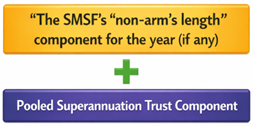
Capital Gains Tax Adjustments
According to the legislation, SMSF Trustees will be given the option to adjust the cost base of the fund’s assets, from the original cost price to the market value of the assets as at 30 June 2026.
The following items are important to note:
- The adjustment would apply to ALL of the SMSF’s assets. Trustees will not be able to select specific assets (i.e. only the ones with unrealised gains).
- This adjustment does not impact the tax treatment of assets for the purposes of the SMSF’s tax return. This is a calculation done separately to the SMSF tax, solely for the purpose of the Division 296 tax.
- Any SMSF can have this adjustment applied, even if the fund does not currently have any members with balances above $3m.
- This change would apply to Properties, including those held under an LRBA / Bare Trust arrangement, but would not apply to the value of assets held in facilities such as Unit Trusts, only the cost base of the units held by the SMSF.
Indexation and Future Movement of Division 296 Thresholds
Public commentary accompanying the current proposal indicates that thresholds may be subject to indexation over time, rather than remaining fixed indefinitely. Indexation is intended to reduce the impact of inflation on balance thresholds and maintain the policy’s focus on higher-balance outcomes.
For trustees, this reinforces the importance of ongoing balance monitoring, particularly where members’ total superannuation balances are approaching relevant thresholds. Indexation does not remove the need for awareness; it simply alters how thresholds may move over time.
Why SMSF Trustees Still Need to Pay Attention
Although Division 296 is assessed to individuals, SMSF trustees play an important role in how the practical consequences of the measure are managed.
Administration and Cash-Flow Awareness
If a member becomes liable for Division 296 tax and elects to meet that liability using funds released from superannuation, the SMSF may be required to process a release request. This can raise practical considerations where the fund holds illiquid assets or maintains limited cash reserves.
Trustees are not required to alter their fund’s investment strategy to accommodate potential future liabilities. However, understanding the fund’s liquidity profile and administrative capacity can reduce pressure if a request arises.
Reporting Accuracy and Timeliness
Division 296 relies on reported balances and related inputs. Inaccurate or delayed reporting can increase the likelihood of reassessments, corrections, or additional queries.
Maintaining accurate financial records, supportable valuations, and timely reporting helps reduce unnecessary administrative complexity, regardless of whether Division 296 ultimately applies to any member.
An Example of How Division 296 Tax May Apply
The following simplified example is provided for general information purposes only and is intended to illustrate how the mechanism operates in principle.
Assume the individual’s total superannuation balance being used for the calculation is $4 million, aggregated across all superannuation interests. If the relevant threshold is $3 million, then $1 million of the individual’s balance sits above that threshold.
If the individual’s calculated superannuation earnings for the year are $200,000, and 25% of their balance is above the threshold, then 25% of the earnings (or $50,000) may be treated as attributable to the portion above the threshold.
An additional tax would then be applied to that attributable amount at the rate specified in the legislation, with the resulting liability assessed to the individual rather than the fund.
This example is intentionally simplified and does not account for legislative refinements, indexation, or individual circumstances.
Key Takeaways
Division 296 tax will be in effect from 1 July 2026. It is aimed at individuals with higher total superannuation balances. Although it is assessed personally, it has potential administrative implications for SMSF trustees.
For trustees, the focus is not on predicting outcomes, but on maintaining strong compliance, reporting, and governance practices so that any future obligations can be managed smoothly if required.
Managing SMSF compliance and reporting obligations can be complex, particularly as superannuation rules evolve. If you would like support with SMSF administration, record-keeping, or ongoing compliance, speak with our team to discuss how we can help.

With over 15 years in superannuation, Millinda Cobban brings extensive experience in SMSF compliance and administration. She has a strong passion for education and helping trustees navigate complex regulatory requirements with clear, practical support.
GENERAL ADVICE DISCLAIMER: This article is general information only and does not constitute financial, taxation, or legal advice. It has been prepared without taking into account your objectives, financial situation, or needs. You should consider whether the information is appropriate to your circumstances and seek professional advice before acting on it.